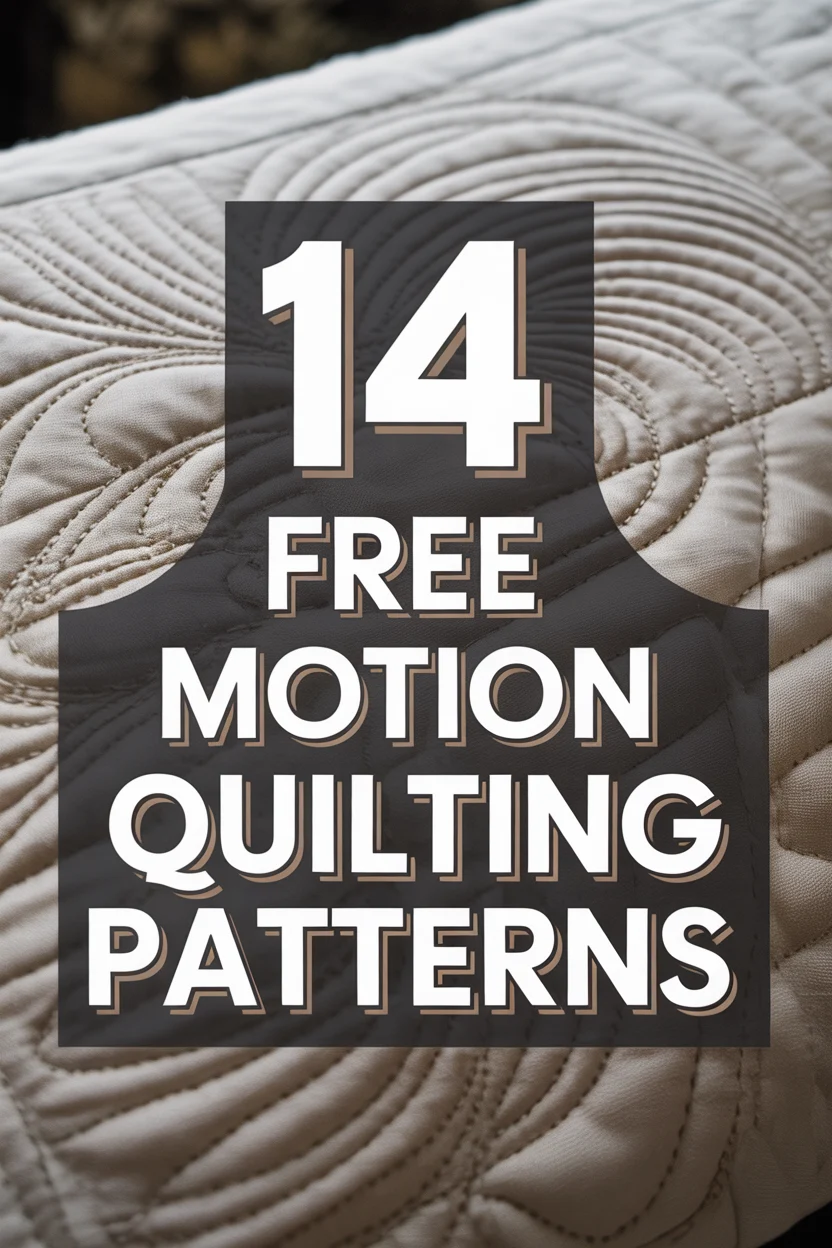
🧵 14 Free Motion Quilting Patterns
& CRAFT IDEAS
Beginner-friendly tutorials, creative projects,
and weekly inspiration in your inbox.
🛠️ The Ultimate Maker's Toolkit
I've tested thousands of craft tools over the years. Whether you are quilting, crafting, or building mixed-media art, these are the top 5 absolute non-negotiable tools I personally recommend to guarantee professional results.
🪡 SINGER Heavy Duty 4452 Sewing Machine
The sewing community highly recommends this as the ultimate "bulletproof" entry-level machine. Its heavy metal frame powerfully pushes through thick denim and heavy quilt layers that would instantly jam a standard plastic machine.
✂️ Fiskars 8" Orange-Handled Scissors
Never settle for dull dollar-store blades. Wirecutter repeatedly names Fiskars the absolute best all-purpose craft scissor due to its legendary precision-ground blades and an ergonomic grip that prevents hand-cramping.
🔥 Gorilla Dual Temp Hot Glue Gun
Named Wirecutter's top choice because it literally does the work of two tools. It features dual-temperature settings offering low heat for delicate florals and blistering high heat for heavy wood adhesion repairs.
🖌️ Mod Podge Waterbase Gloss Sealer
The absolute undisputed champion of decoupage and paper crafts. Experts rely exclusively on this exact water-based formula because it glues, seals, and finishes beautifully without yellowing or flaking over time.
🎨 Apple Barrel Acrylic Paint (2 oz)
The quintessential, incredibly inexpensive craft paint. Woodworkers and hobby painters swear by its smooth flow and matte finish, providing massive value and remarkably thick color coverage on rough surfaces.
Staring at that gorgeous quilt top, feeling a tiny panic about the actual quilting part?
Totally get it. That blank canvas can be intimidating, right?
But guess what. Free motion quilting is actually your secret weapon for adding personality without the stress.
I’ve rounded up 14 totally doable ideas to get your needle dancing, even if you think your machine only goes in straight lines.
1. Stipple/Meander
- Best For: Beginners, all-over texture
- Vibe: Subtle, cloud-like
- Why it works: Hides imperfections like a pro
This one’s the OG for a reason. Imagine tiny, irregular puzzle pieces fitting together, but without any sharp corners.
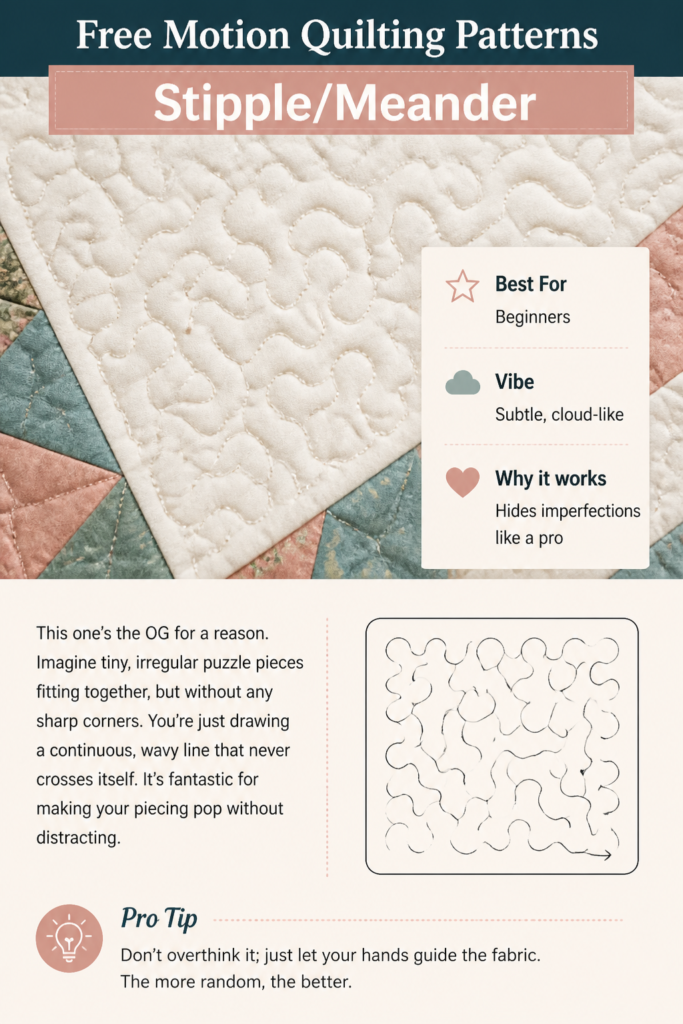
You’re just drawing a continuous, wavy line that never crosses itself. It’s fantastic for making your piecing pop without distracting.
Pro Tip: Don’t overthink it; just let your hands guide the fabric. The more random, the better.
2. Loops
- Best For: Baby quilts, modern designs
- Vibe: Whimsical, lighthearted
- Why it works: Adds movement and softness
Think of drawing a series of interconnected bubbles or cursive ‘e’s all over your quilt.
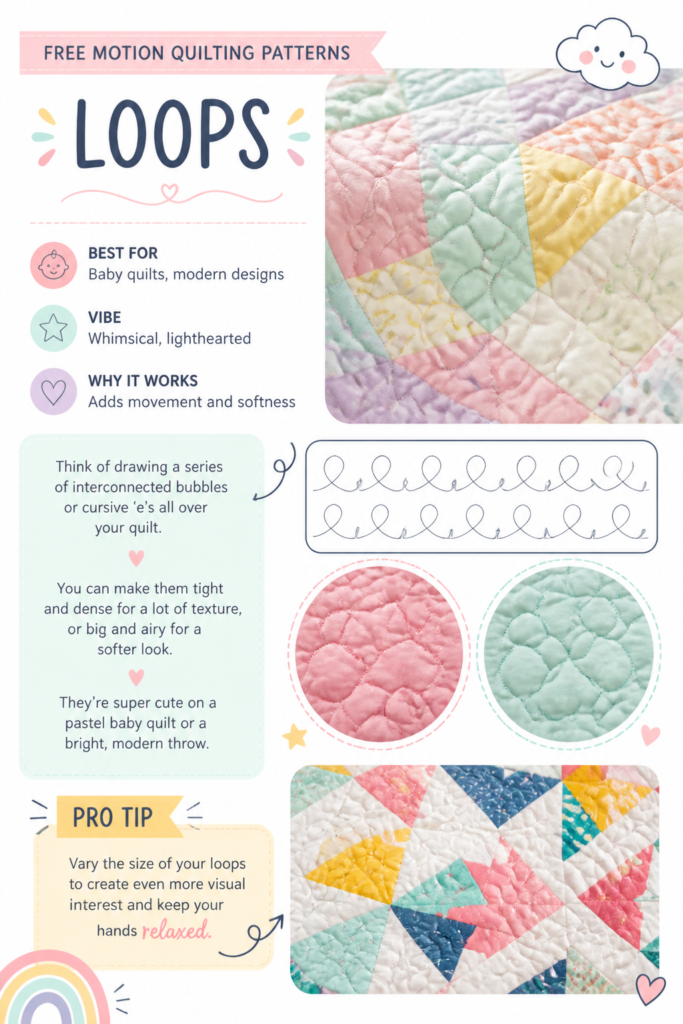
You can make them tight and dense for a lot of texture, or big and airy for a softer look. They’re super cute on a pastel baby quilt or a bright, modern throw.
Pro Tip: Vary the size of your loops to create even more visual interest and keep your hands relaxed.
3. Swirls/Curlicues
- Best For: Floral quilts, borders
- Vibe: Sophisticated, natural
- Why it works: Mimics natural forms and adds flow
These are like fancy little snail shells or the tendrils of a vine. Start with a central point and spiral outwards, then connect to another swirl.
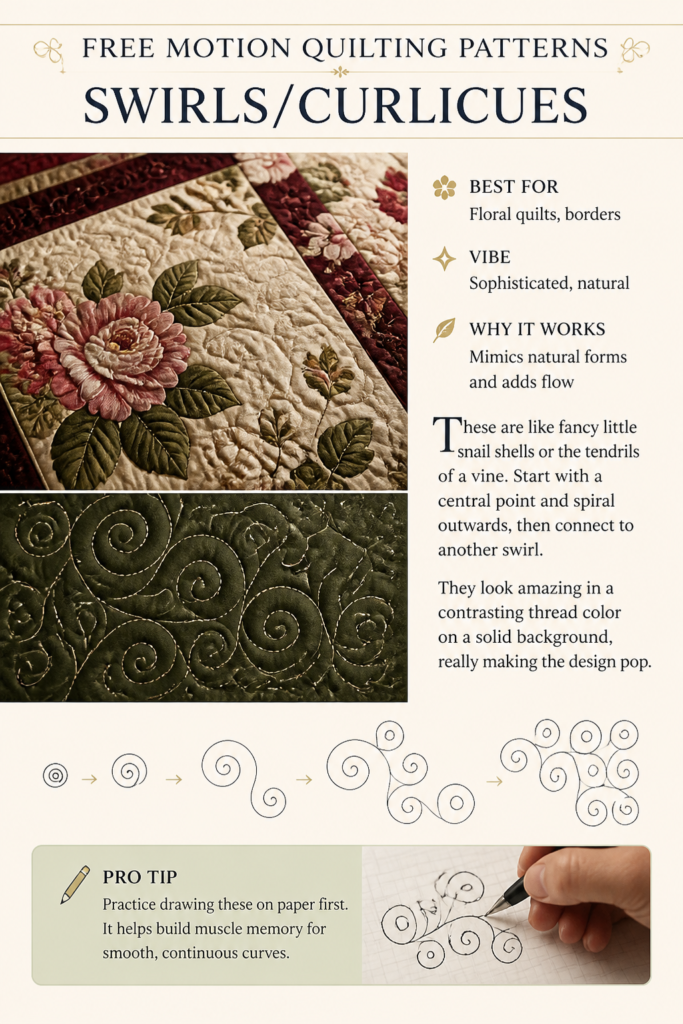
They look amazing in a contrasting thread color on a solid background, really making the design pop.
Pro Tip: Practice drawing these on paper first. It helps build muscle memory for smooth, continuous curves.
4. Pebbles
- Best For: Background filler, negative space
- Vibe: Organic, stone-like
- Why it works: Creates incredible dimension and texture
You’re essentially drawing circles, then drawing more circles around them, nesting them like little river stones.
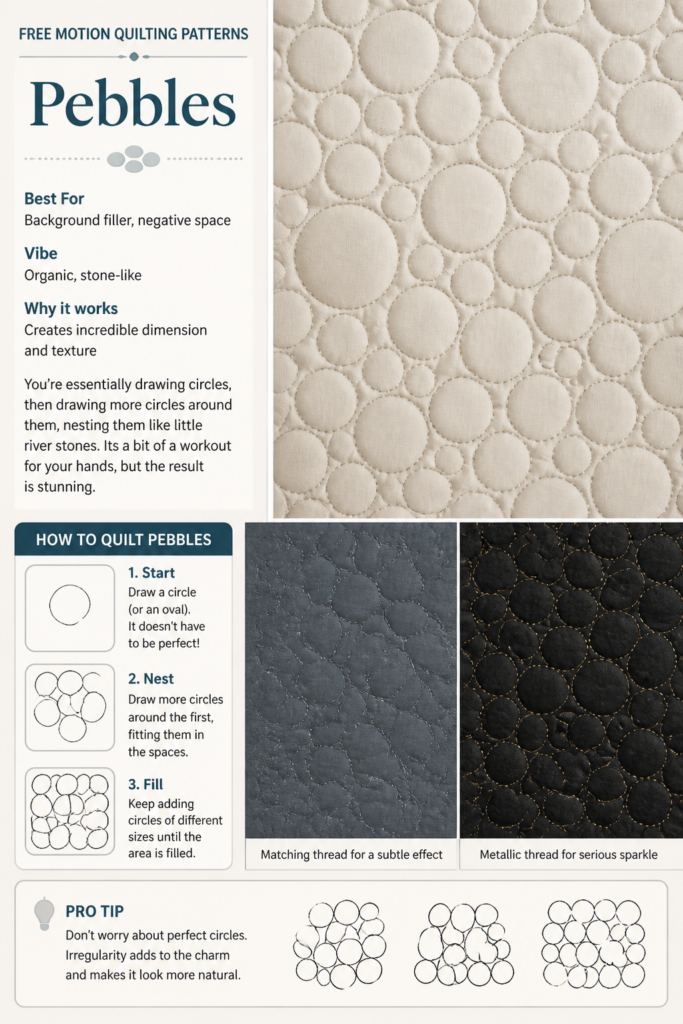
It’s a bit of a workout for your hands, but the result is stunning. Use a matching thread for a subtle effect, or a metallic one for serious sparkle.
Pro Tip: Don’t worry about perfect circles. Irregularity adds to the charm and makes it look more natural.
5. Feathers
- Best For: Traditional quilts, heirloom pieces
- Vibe: Elegant, luxurious
- Why it works: Adds a timeless, intricate beauty
Okay, this one takes a little practice, but it’s totally worth it. You’re building a spine and then adding graceful, curved plumes off each side.
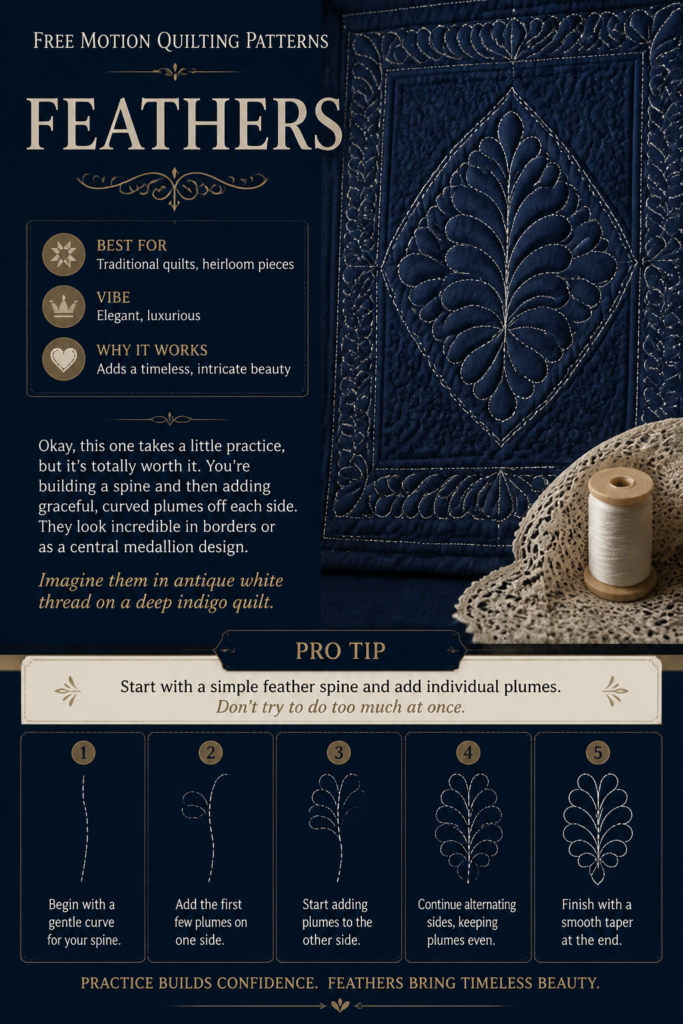
They look incredible in borders or as a central medallion design. Imagine them in an antique white thread on a deep indigo quilt.
Pro Tip: Start with a simple feather spine and add individual plumes. Don’t try to do too much at once.
6. Continuous Curves
- Best For: Sashing, modern quilts
- Vibe: Clean, contemporary
- Why it works: Provides a sleek, structured look with movement
This is basically drawing a series of evenly spaced, gentle “S” or “C” curves. You’re creating a wave-like pattern that can be scaled up or down.
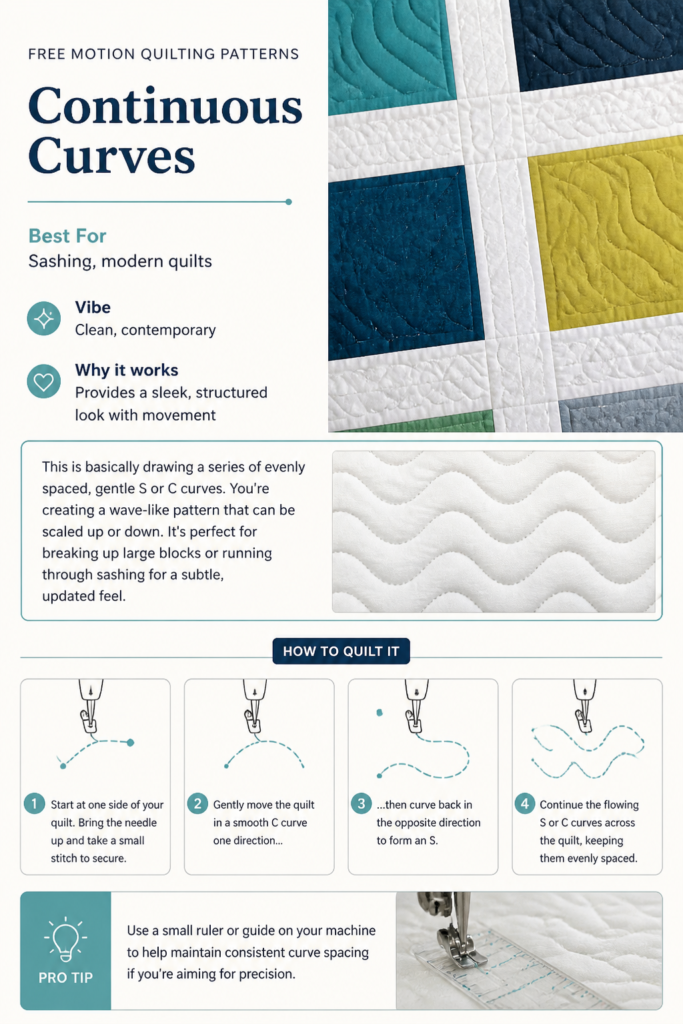
It’s perfect for breaking up large blocks or running through sashing for a subtle, updated feel.
Pro Tip: Use a small ruler or guide on your machine to help maintain consistent curve spacing if you’re aiming for precision.
7. Paisley
- Best For: Boho vibes, unique accents
- Vibe: Exotic, artistic
- Why it works: Adds a distinctive, stylized organic element
Think of those classic teardrop shapes with a little curl at the end. You connect them by making the curl of one lead into the body of the next.
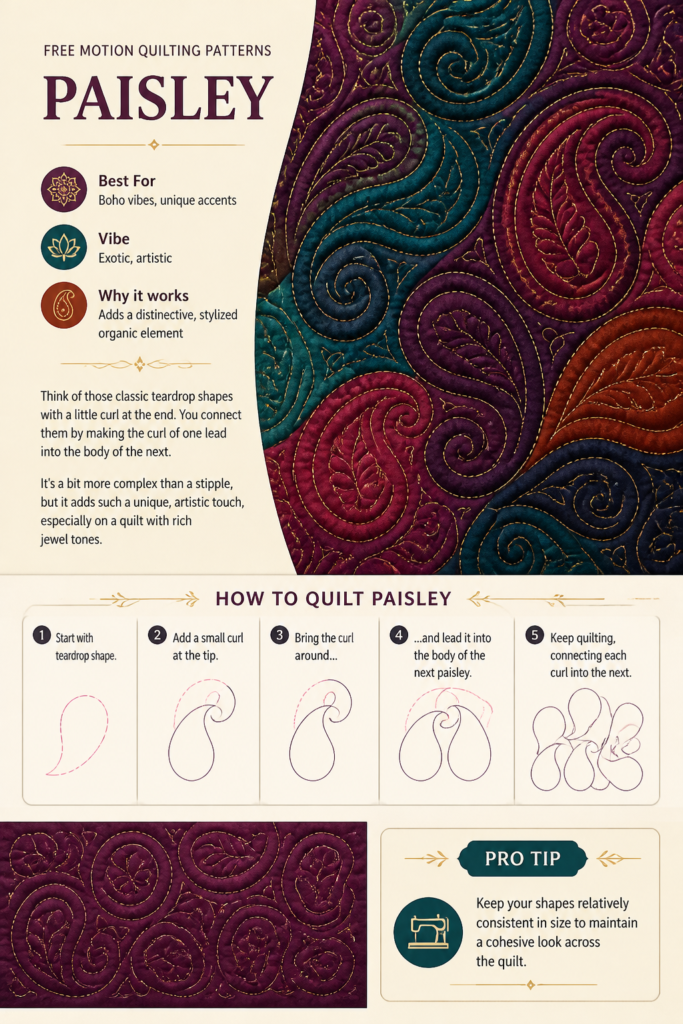
It’s a bit more complex than a stipple, but it adds such a unique, artistic touch, especially on a quilt with rich jewel tones.
Pro Tip: Keep your shapes relatively consistent in size to maintain a cohesive look across the quilt.
8. Woodgrain
- Best For: Nature-themed quilts, masculine designs
- Vibe: Earthy, organic
- Why it works: Creates a natural, grounded texture
This pattern mimics the rings and knots of wood. You’re drawing long, wavy lines that occasionally branch off or enclose a “knot” shape.
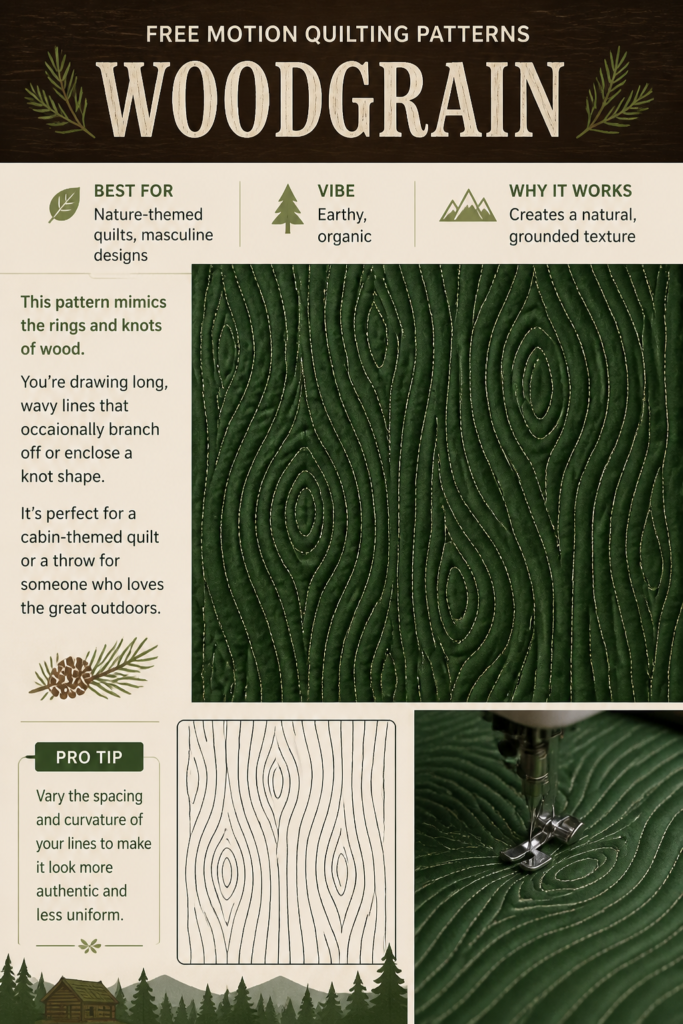
It’s perfect for a cabin-themed quilt or a throw for someone who loves the great outdoors. Imagine it on a deep forest green fabric.
Pro Tip: Vary the spacing and curvature of your lines to make it look more authentic and less uniform.
9. Ribbon Candy
- Best For: Kids’ quilts, playful accents
- Vibe: Sweet, energetic
- Why it works: Creates a playful, interlocking texture
This one looks like those old-fashioned hard candies. You’re drawing a series of connected “U” shapes that alternate direction, creating a continuous ribbon effect.
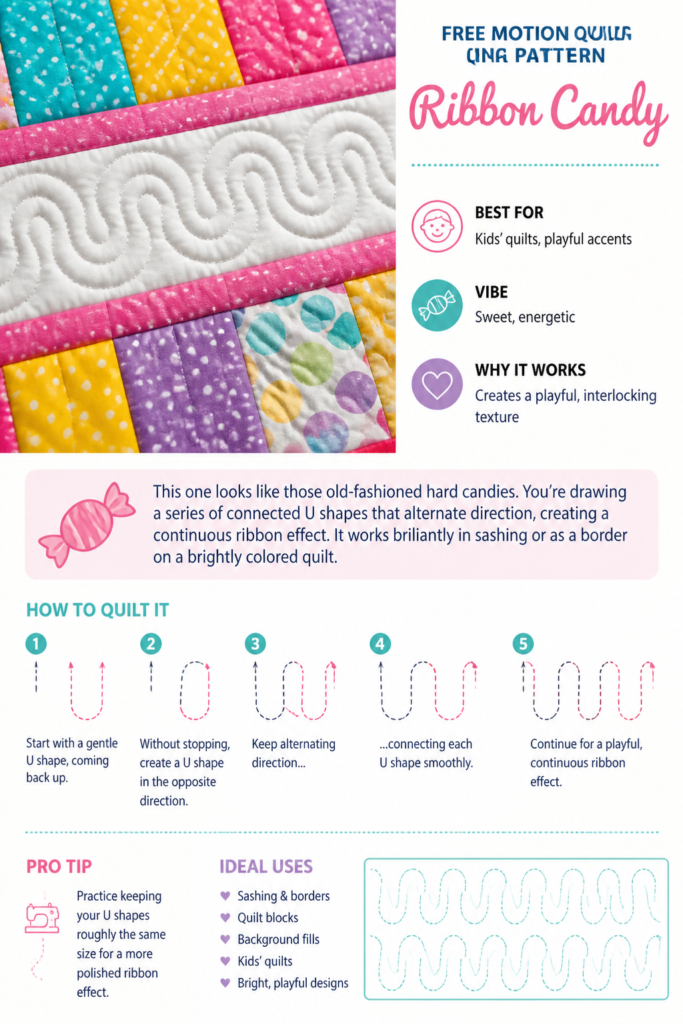
It works brilliantly in sashing or as a border on a brightly colored quilt.
Pro Tip: Practice keeping your “U” shapes roughly the same size for a more polished ribbon effect.
10. Orange Peel
- Best For: Modern quilts, geometric blocks
- Vibe: Bold, graphic
- Why it works: Creates a striking, interlocking pattern
You’re essentially drawing overlapping arcs that create the illusion of orange segments. This pattern looks fantastic in a grid, defining squares or rectangles.
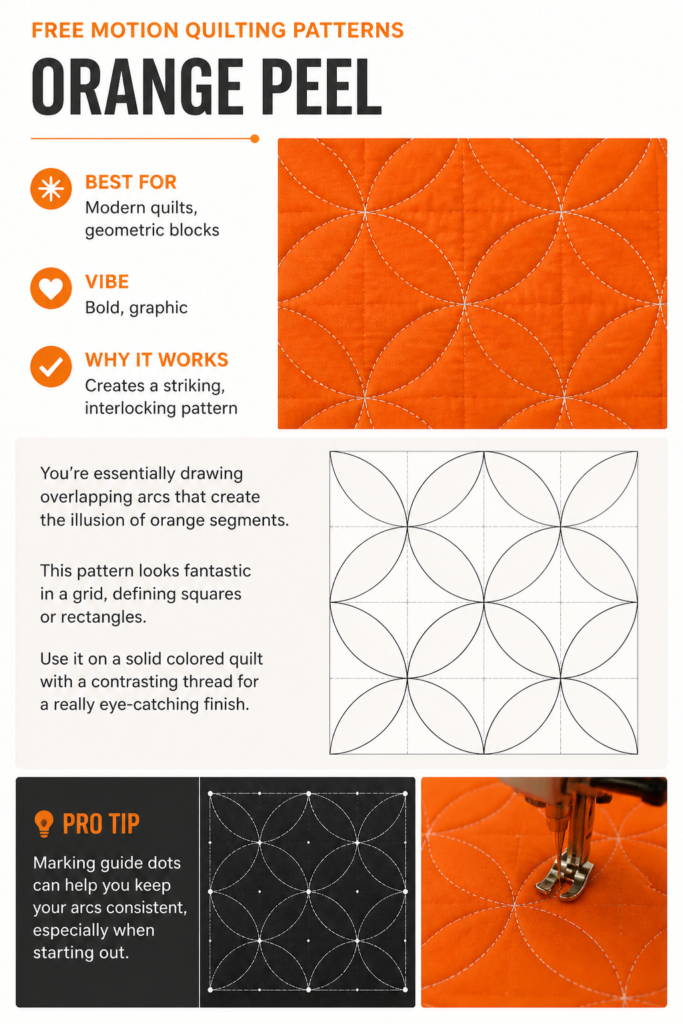
Use it on a solid colored quilt with a contrasting thread for a really eye-catching finish.
Pro Tip: Marking guide dots can help you keep your arcs consistent, especially when starting out.
11. Wavy Lines
- Best For: Quick texture, minimalist designs
- Vibe: Relaxed, flowing
- Why it works: Adds movement without complexity
Just what it sounds like: continuous, parallel wavy lines across your quilt. You can make them tight or loose, wide or narrow.
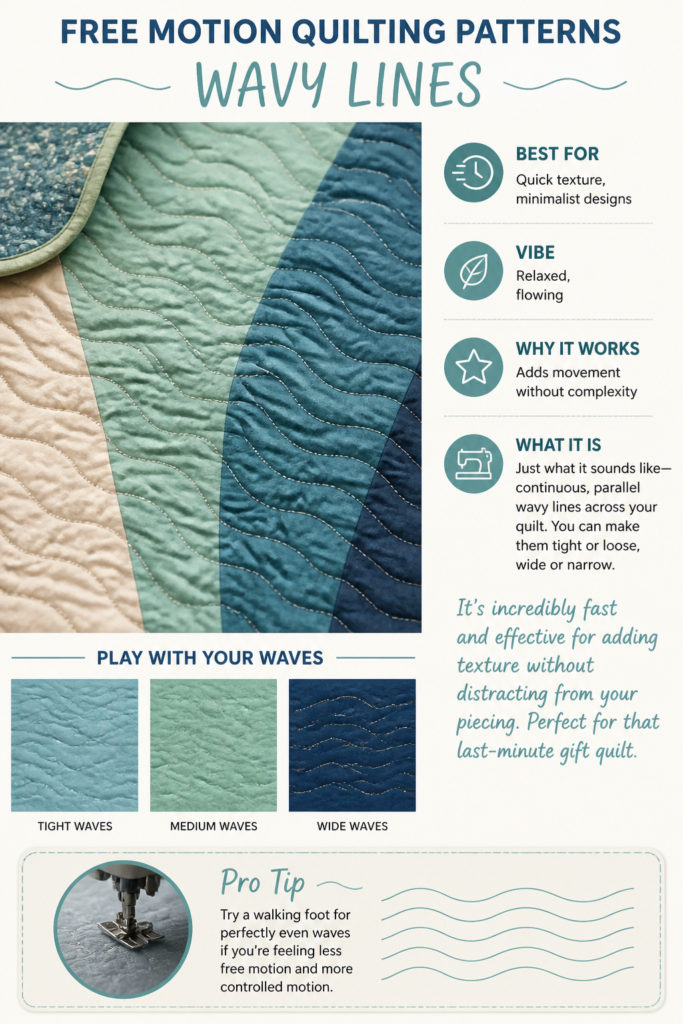
It’s incredibly fast and effective for adding texture without distracting from your piecing. Perfect for that last-minute gift quilt.
Pro Tip: Try a walking foot for perfectly even waves if you’re feeling less “free motion” and more “controlled motion.”
12. Leaves/Vines
- Best For: Botanical quilts, autumn themes
- Vibe: Organic, serene
- Why it works: Brings a natural, gentle touch
You’re drawing a central vine or stem and then adding simple leaf shapes branching off. Vary the size and shape of the leaves for a more natural look.
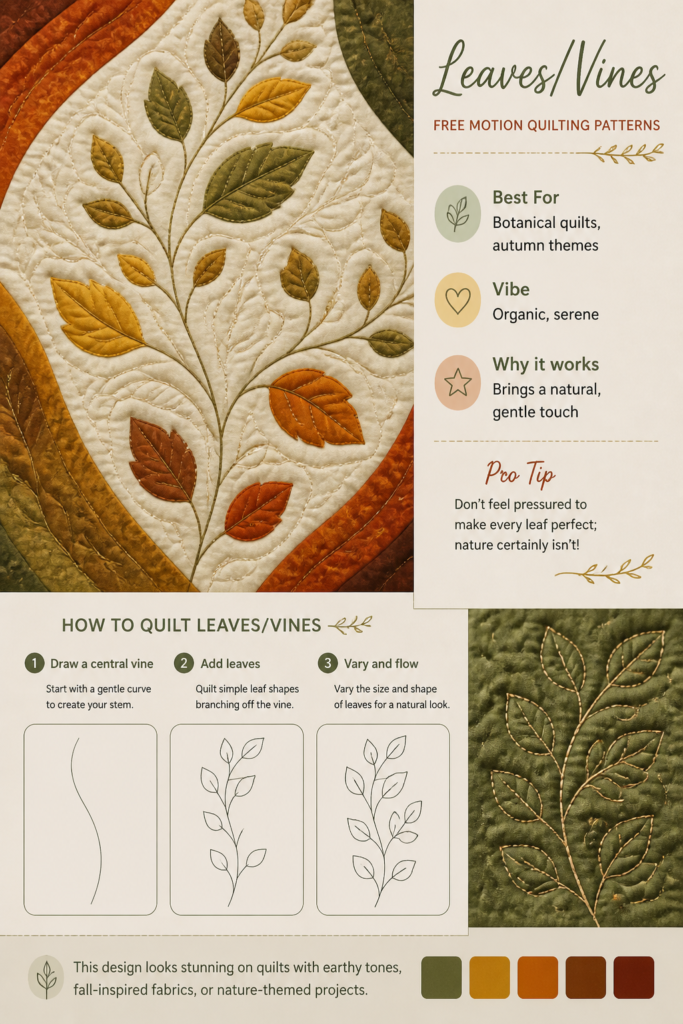
This would be stunning on a quilt with earthy tones or a fall-themed design.
Pro Tip: Don’t feel pressured to make every leaf perfect; nature certainly isn’t!
13. Grid Work (Freehand)
- Best For: Modern minimalist quilts, defining areas
- Vibe: Clean, architectural
- Why it works: Adds a subtle, structured texture without being rigid
This involves quilting straight-ish lines in a grid pattern, but freehand. The slight wobble from not using a ruler gives it a softer, more organic feel than ruler work.
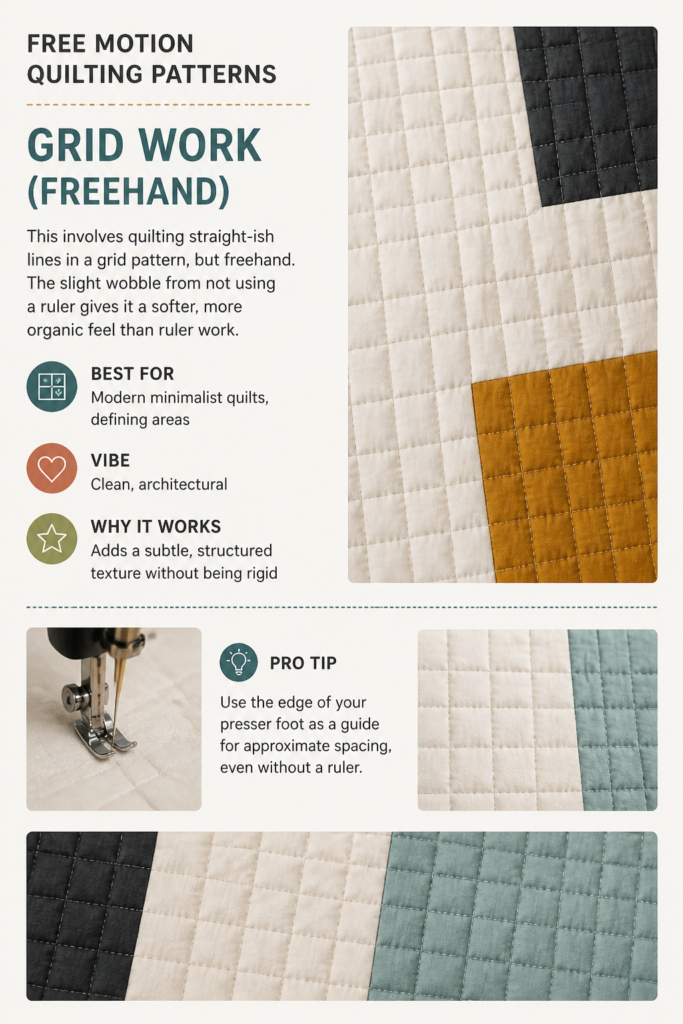
It’s fantastic for modern quilts where you want texture but not a fussy design.
Pro Tip: Use the edge of your presser foot as a guide for approximate spacing, even without a ruler.
14. Wishbone
- Best For: Borders, sashing, dense texture
- Vibe: Classic, intricate
- Why it works: Creates a beautiful, continuous chain
This pattern looks like a series of connected wishbones or “V” shapes. You quilt a V, then loop back to the start of the next V, creating an interlocking chain.
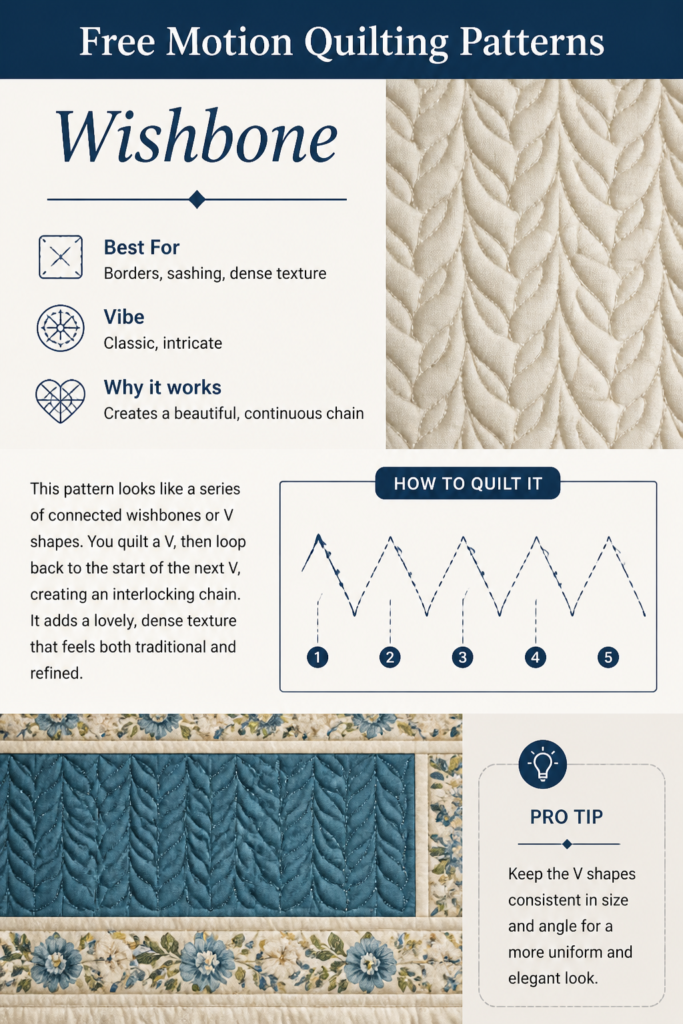
It adds a lovely, dense texture that feels both traditional and refined.
Pro Tip: Keep the “V” shapes consistent in size and angle for a more uniform and elegant look.
Our Top Recommended Finds
Ready to dive in? A few essentials can really make a difference.
- Quilting Gloves: Seriously, these are a game-changer for gripping your fabric. Think of them as tiny superpowers for your hands.
- Supreme Slider: This slick mat goes on your machine bed and makes fabric glide like it’s on ice. Less drag, more flow.
- Good Quality Thread: A strong, low-lint thread (like Aurifil 50wt cotton) is your best friend. It breaks less and looks smoother, making your stitches sing.
Which of these will you try first?
See? Free motion quilting isn’t some mystical art reserved for grandmas (though they rock it, obviously).
It’s about having fun, letting go, and adding that final, unique touch to your textile masterpiece.
So, grab that quilt top and tell us, which pattern is calling your name for its debut performance?
& CRAFT IDEAS
Beginner-friendly tutorials, creative projects,
and weekly inspiration in your inbox.