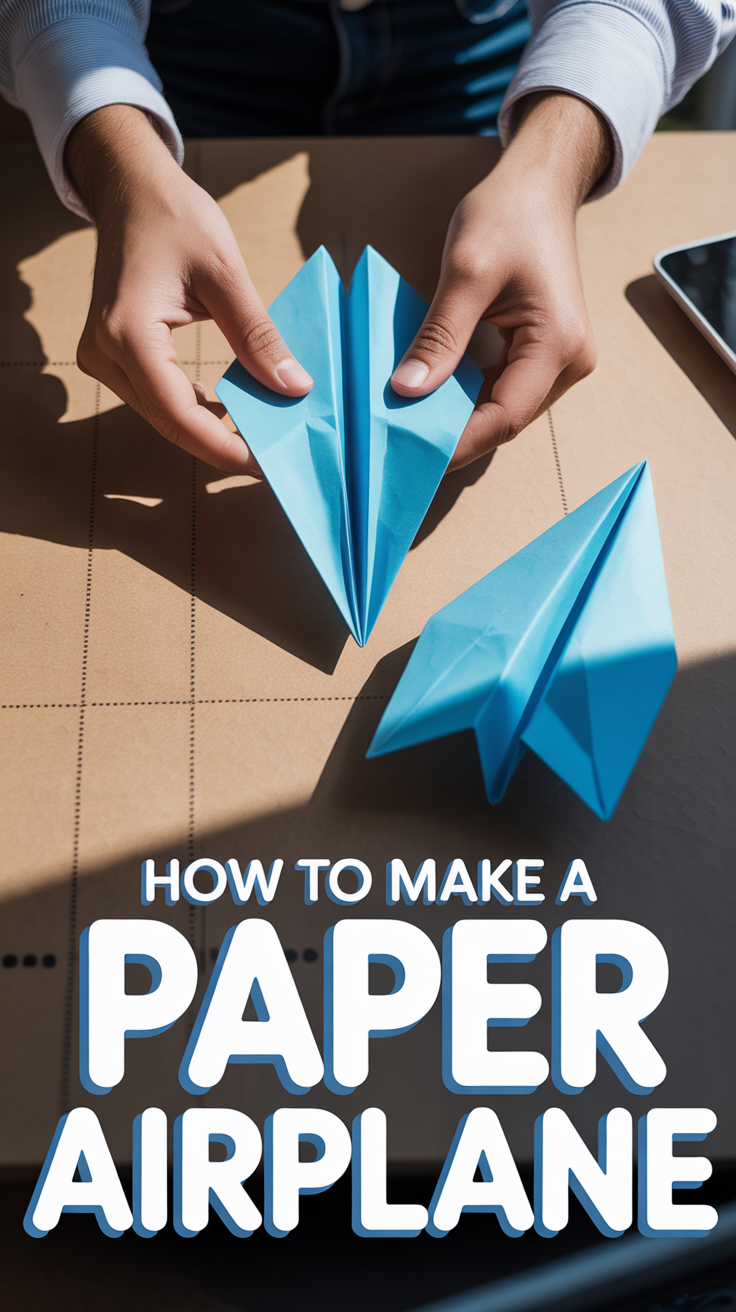
✈️ How To Make A Paper Airplane
Got a sheet of paper and a tiny urge to defy gravity? Perfect. We’re folding our way to instant aviation glory—no pilot’s license, just vibes. Follow along and you’ll have a fleet that soars, dives, and flexes on office air currents like a pro.
1. Classic Dart
The OG. Fast, simple, and reliable. This one slices through the air like it has somewhere to be.
Fold the paper lengthwise, then bring top corners to the center line. Fold the nose down to tighten weight at the front. Fold wings down evenly, keeping the leading edges crisp.
Pro tip: Add a tiny upward bend at the back of each wing (dihedral) for better stability.
It works because the sharp nose and straight center line give you speed and balance.
2. Bulldog Glider
Short nose, big attitude. Slow and steady wins the long glide.
Fold the top third down, then bring corners to the center of that fold. Fold in half, then create wide wings. Add small winglets for control.
Pro tip: Slightly round the nose fold to avoid stall and nose dives.
It works thanks to a forward weight and broad wing surface that keeps lift cozy and stable.
3. Nakamura Lock
Locks like a vault, flies like a dream. Great for beginners who hate planes unfolding mid-flight.
Fold in half lengthwise, then top corners to center. Fold the nose down over those corners to “lock” them. Fold wings and pinch the body tight.
Pro tip: Press the nose crease hard—this locks layers so nothing flaps loose.
It works because the locked nose keeps airflow clean and weight centered.
4. The Canary Glider
Gentle launch, long float. Perfect for “let’s not break the lamp.”
Fold in half, then create shallow angles to the center—less aggressive than a dart. Wings go wide with slight upward tips.
Pro tip: Give it a soft push, not a fast throw—this maximizes glide.
It works because big, flat wings boost lift over speed.
5. The Hammerhead
Weighted nose, dramatic dives. Showy and fun indoors.
Fold top edge down twice to create a heavy nose. Bring corners to center, then fold wings. Keep symmetry tight.
Pro tip: If it drops too fast, add tiny up-bends at the tail to trim.
It works because the front-heavy design stabilizes the flight path and resists wobble.
6. Winged Arrow
Sleek and lean. Goes far with a clean throw.
Create a sharp center line, bring corners down tightly, then refine the nose with an extra fold. Fold narrow wings with minimal dihedral.
Pro tip: Use smooth paper for less drag and more distance.
It works by balancing a sharp nose with slim wings for low resistance.
7. Sea Gull
Curvy wings for graceful arcs. It looks fancy and flies smooth.
Fold the base, then make wings with a gentle upward curve. Add winglets to keep air under control.
Pro tip: Pinch the mid-body slightly to form a dihedral angle for stability.
It works because curved wings manage lift distribution and reduce roll.
8. The Boomerang
Short loop and return (ish). Fun for small spaces.
Fold asymmetrically: one wing slightly larger. Angle both tips up. Throw with a slight tilt.
Pro tip: Aim for a gentle, curved release—no baseball fastballs.
It works by exploiting imbalanced lift to arc back toward you.
9. Long-Range Cruiser
Built for distance. Minimal drama, maximum travel.
Make a tight nose and long, narrow wings. Keep all folds crisp and symmetrical. Add tiny rear elevators to trim.
Pro tip: Throw at a slight upward angle with moderate force.
It works because the slim profile reduces drag and holds speed.
10. Stunt Flipper
Loop-de-loops on command. Because flying straight is overrated.
Create a mid-heavy body with thick nose folds and short wings. Bend tail up a touch.
Pro tip: For tighter loops, add a slight upward bend to both wings’ rear edges.
It works by shifting the center of gravity to encourage looping.
11. Heavy Glider
Thiccc nose, controlled glide. Great in light wind.
Triple-fold the top for weight, then form broad wings. Adjust winglets to fine-tune yaw.
Pro tip: If it veers, bend the trailing edge opposite the drift.
It works because extra mass up front prevents stalls while wings carry the ride.
12. Pocket Jet
Tiny but mighty. Fits in your notebook, terrorizes boredom.
Use half-sheet paper. Keep folds ultra clean. Make narrow wings and a pointed nose.
Pro tip: Use heavier paper to avoid floppiness at small scale.
It works by concentrating weight and stiffness into a compact frame.
13. Broadwing Soarer
Wide wings, slow drama. Hangs in the air like it pays rent.
Build a modest nose, then unfold generous wings. Add slight upward winglets.
Pro tip: Launch from a height and glide gently—no hard throws.
It works because the large surface area creates lift at low speeds.
14. Precision Pointer
Accuracy first. Lands exactly where you meant. Mostly.
Form a tight nose and straight center line. Keep wing edges perfectly aligned.
Pro tip: Sight along the center crease before each throw to check alignment.
It works by combining symmetry and a stable nose for predictable paths.
15. The Crowd-Pleaser
Looks cool, flies cooler. Perfect for “watch this” moments.
Layered nose, medium wings, clean winglets. Smooth edges for style and function.
Pro tip: Add a tiny paperclip at the nose for extra range and stability.
It works because added forward mass plus tidy aerodynamics equals crisp performance.
Conclusion
Paper plus a few folds equals instant flight and bragging rights. Pick your vibe—speed, glide, or stunt—and tweak the wings until it flies like it’s reading your mind. Keep folds sharp, trims tiny, and launches confident. Your desk just became a runway.