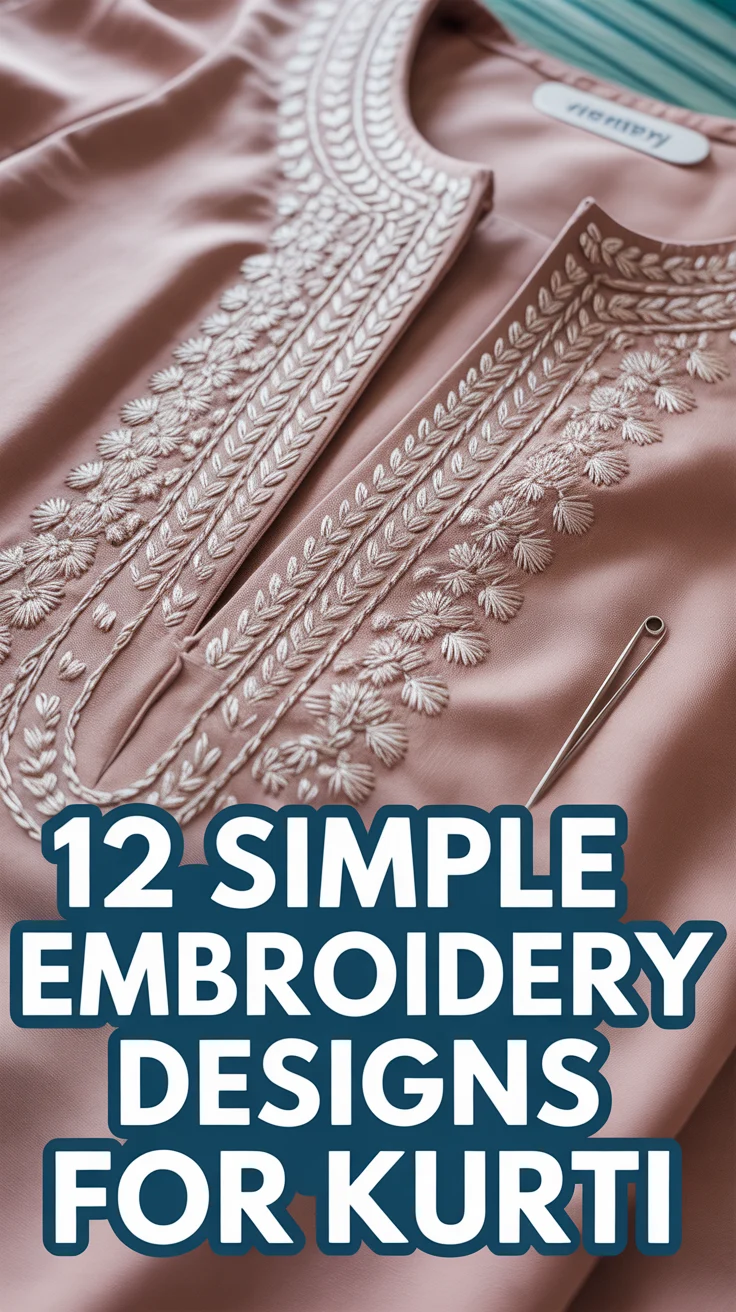
🧵 12 Simple Machine Embroidery Designs For Blouse
& CRAFT IDEAS
Beginner-friendly tutorials, creative projects,
and weekly inspiration in your inbox.
🛠️ The Ultimate Maker's Toolkit
I've tested thousands of craft tools over the years. Whether you are quilting, crafting, or building mixed-media art, these are the top 5 absolute non-negotiable tools I personally recommend to guarantee professional results.
🪡 SINGER Heavy Duty 4452 Sewing Machine
The sewing community highly recommends this as the ultimate "bulletproof" entry-level machine. Its heavy metal frame powerfully pushes through thick denim and heavy quilt layers that would instantly jam a standard plastic machine.
✂️ Fiskars 8" Orange-Handled Scissors
Never settle for dull dollar-store blades. Wirecutter repeatedly names Fiskars the absolute best all-purpose craft scissor due to its legendary precision-ground blades and an ergonomic grip that prevents hand-cramping.
🔥 Gorilla Dual Temp Hot Glue Gun
Named Wirecutter's top choice because it literally does the work of two tools. It features dual-temperature settings offering low heat for delicate florals and blistering high heat for heavy wood adhesion repairs.
🖌️ Mod Podge Waterbase Gloss Sealer
The absolute undisputed champion of decoupage and paper crafts. Experts rely exclusively on this exact water-based formula because it glues, seals, and finishes beautifully without yellowing or flaking over time.
🎨 Apple Barrel Acrylic Paint (2 oz)
The quintessential, incredibly inexpensive craft paint. Woodworkers and hobby painters swear by its smooth flow and matte finish, providing massive value and remarkably thick color coverage on rough surfaces.
Let’s give your blouses a glow-up without a week-long craft marathon. These simple machine embroidery ideas are quick, stylish, and absolutely wearable. Think clean lines, fuss-free stitches, and maximum compliments with minimum chaos. Ready to stitch and slay?
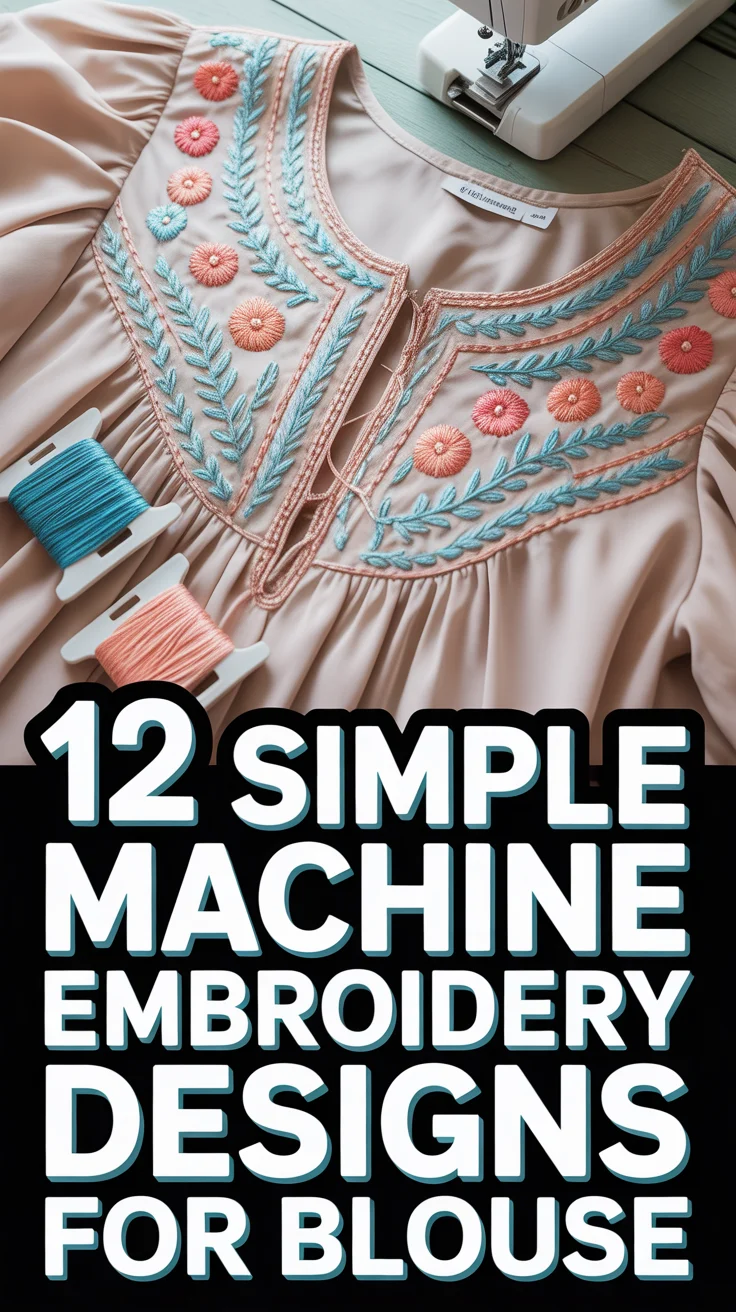
1. Minimalist Neckline V Vine
Soft vines curved into a V at the neckline look elegant without shouting. It frames the face and adds detail where it counts. Keep the leaves tiny for a modern finish.
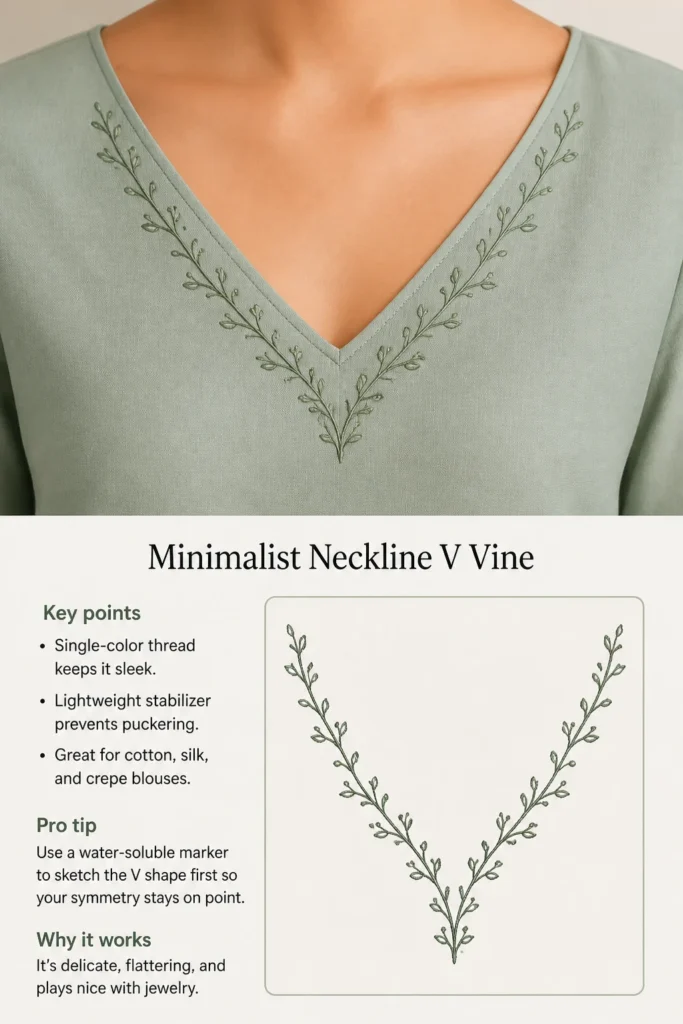
Key points:
- Single-color thread keeps it sleek.
- Lightweight stabilizer prevents puckering.
- Great for cotton, silk, and crepe blouses.
Pro tip: Use a water-soluble marker to sketch the V shape first so your symmetry stays on point.
Why it works: It’s delicate, flattering, and plays nice with jewelry.
2. Scalloped Sleeve Edge
Clean scallops along the sleeve hem add instant charm. It’s simple geometry, but make it cute. Perfect for short and three-quarter sleeves.
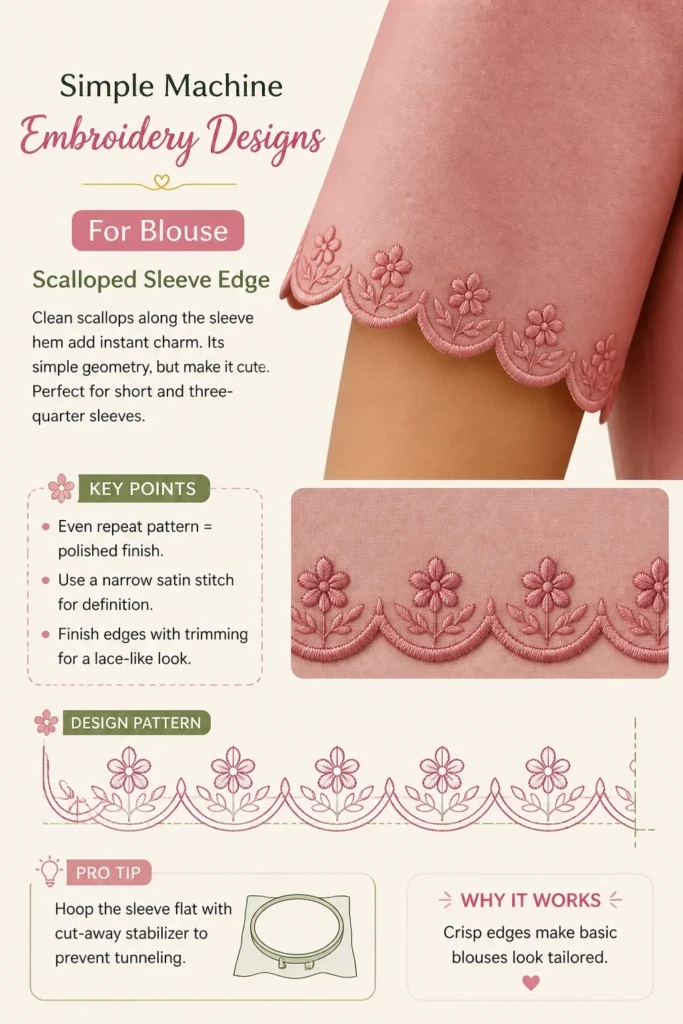
Key points:
- Even repeat pattern = polished finish.
- Use a narrow satin stitch for definition.
- Finish edges with trimming for a lace-like look.
Pro tip: Hoop the sleeve flat with cut-away stabilizer to prevent tunneling.
Why it works: Crisp edges make basic blouses look tailored.
3. Geometric Yoke Dots
Tiny satin-stitched dots arranged in a triangle grid across the yoke. It’s playful but controlled. Also hides any puckers like a pro.
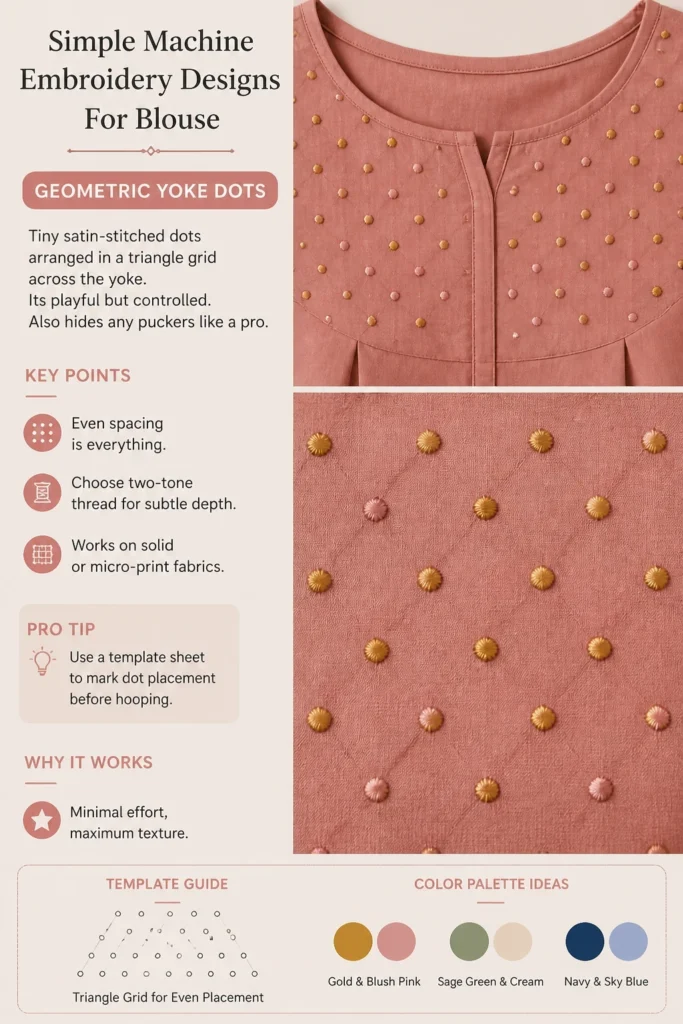
Key points:
- Even spacing is everything.
- Choose two-tone thread for subtle depth.
- Works on solid or micro-print fabrics.
Pro tip: Use a template sheet to mark dot placement before hooping.
Why it works: Minimal effort, maximum texture.
4. Paisley Corner Motifs
Small paisley motifs placed at shoulder corners or near the hem. It feels classic without the heavy bridal vibe. Great for beginners using built-in machine designs.
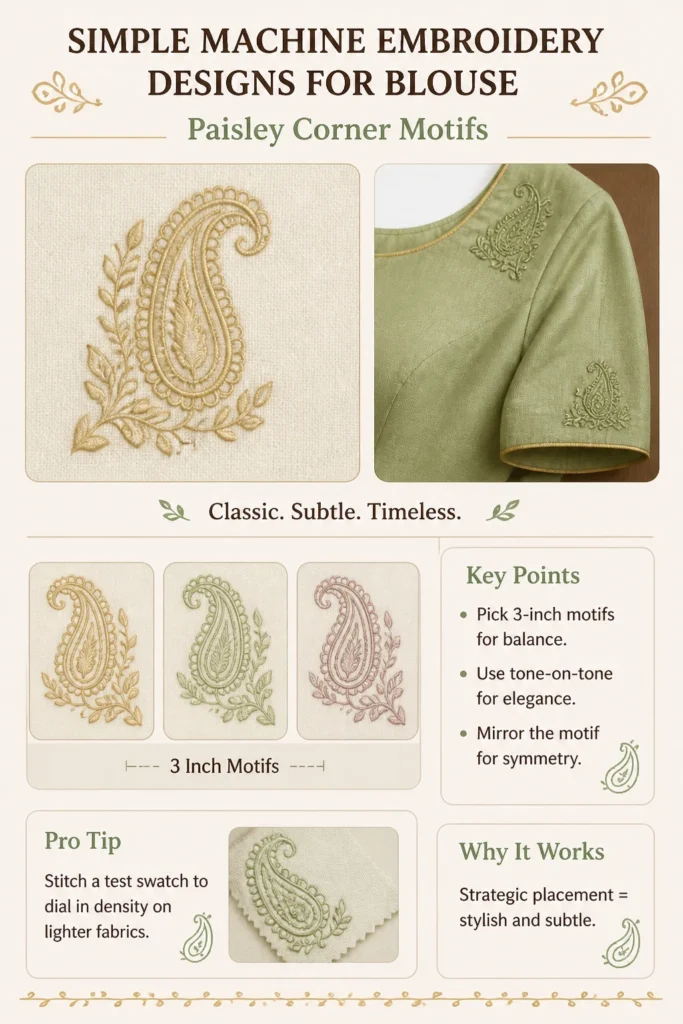
Key points:
- Pick 3-inch motifs for balance.
- Use tone-on-tone for elegance.
- Mirror the motif for symmetry.
Pro tip: Stitch a test swatch to dial in density on lighter fabrics.
Why it works: Strategic placement = stylish and subtle.
5. Back Neckline Monogram
A chic monogram at the back neck says custom without trying hard. Pick a clean serif or script. Small but memorable.
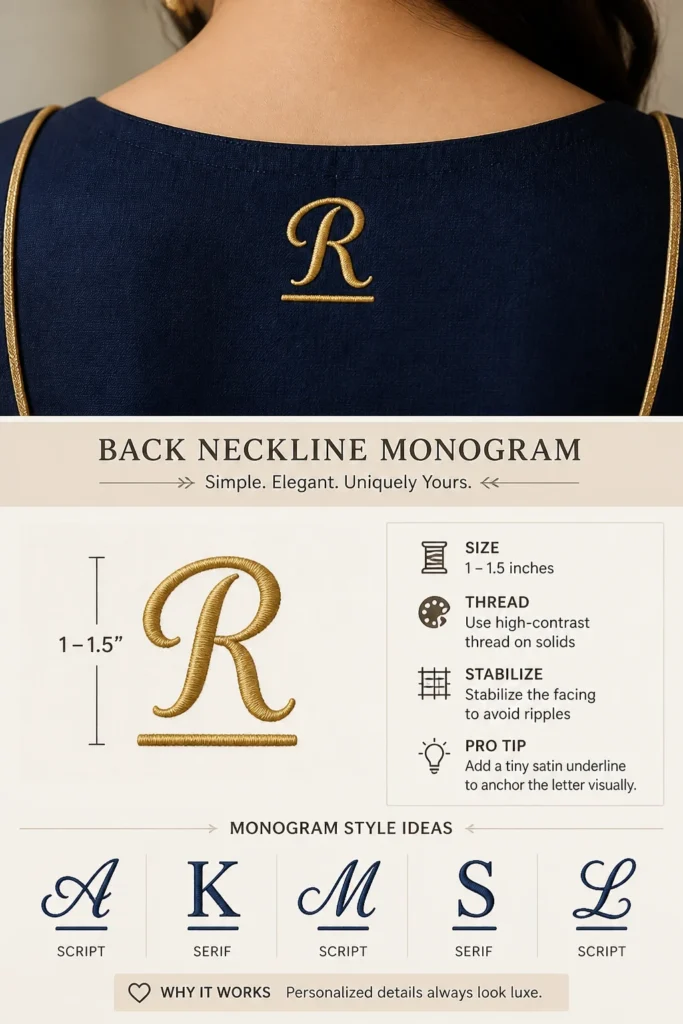
Key points:
- Keep size around 1 to 1.5 inches.
- Use high-contrast thread on solids.
- Stabilize the facing to avoid ripples.
Pro tip: Add a tiny satin underline to anchor the letter visually.
Why it works: Personalized details always look luxe.
6. Floral Shoulder Sprig
A small floral sprig on one shoulder looks fresh and asymmetric. It’s romantic without going full bouquet. Keep petals simple and filled.
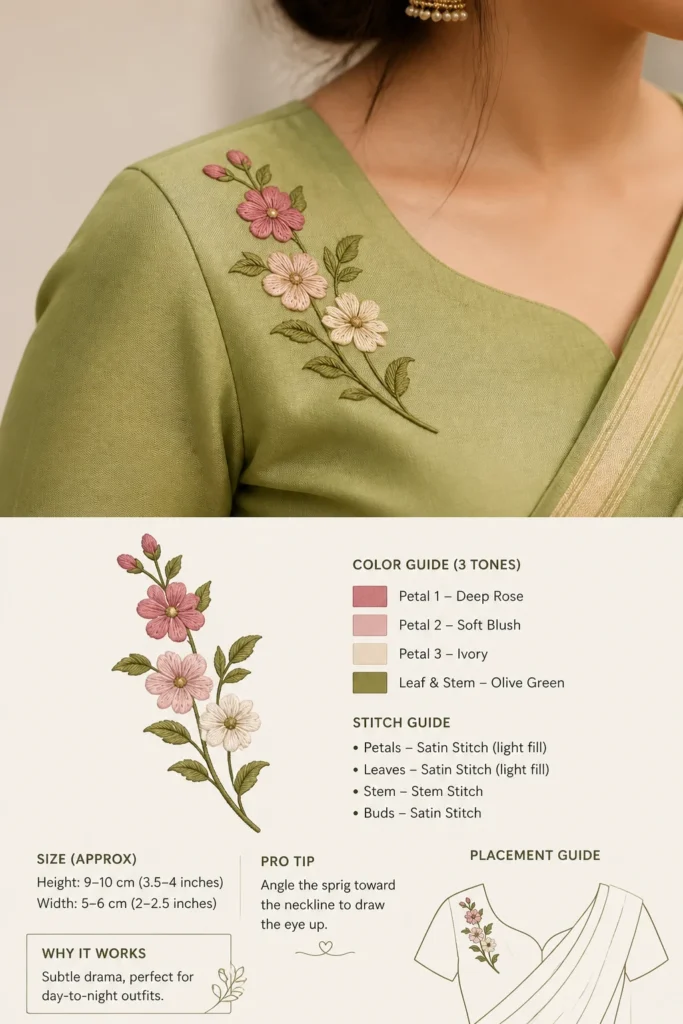
Key points:
- Three-tone palette for petals, leaves, stem.
- Use light fill stitches to avoid stiffness.
- Place slightly forward for visibility.
Pro tip: Angle the sprig toward the neckline to draw the eye up.
Why it works: Subtle drama, perfect for day-to-night outfits.
7. Cuff Border Chevron
A clean chevron line at the sleeve cuffs adds sharp energy. It’s graphic, bold, and ridiculously easy to line up. Works with contrast thread or metallics.
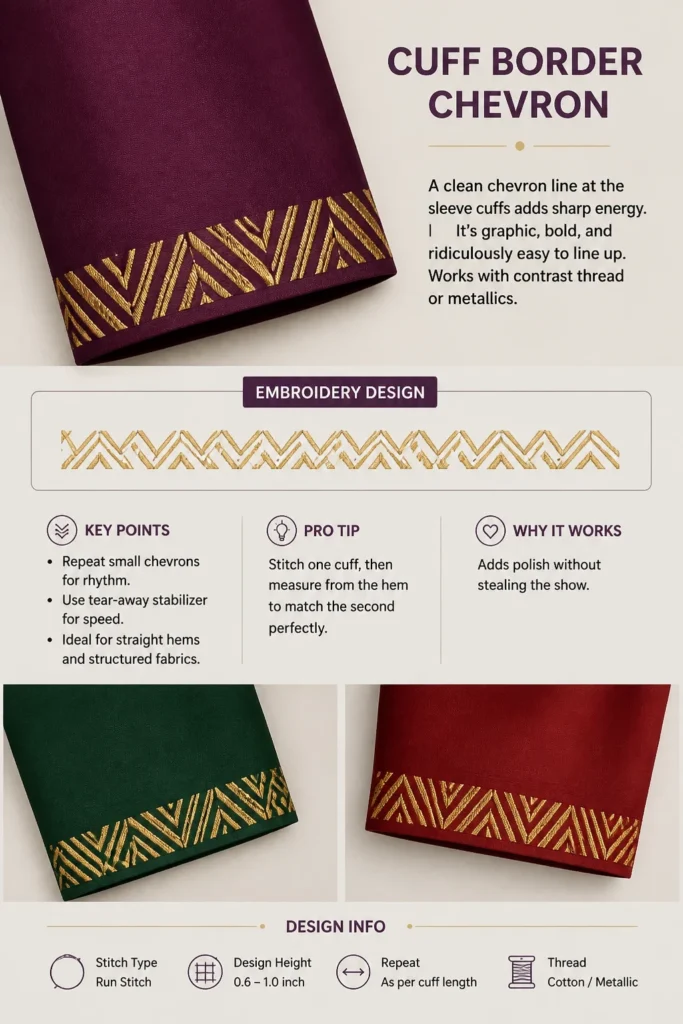
Key points:
- Repeat small chevrons for rhythm.
- Use tear-away stabilizer for speed.
- Ideal for straight hems and structured fabrics.
Pro tip: Stitch one cuff, then measure from the hem to match the second perfectly.
Why it works: Adds polish without stealing the show.
8. Dainty Button Placket Line
A skinny line of motifs flanking the button placket. Think tiny diamonds or mini leaves. The hint of embroidery elevates every button-up.
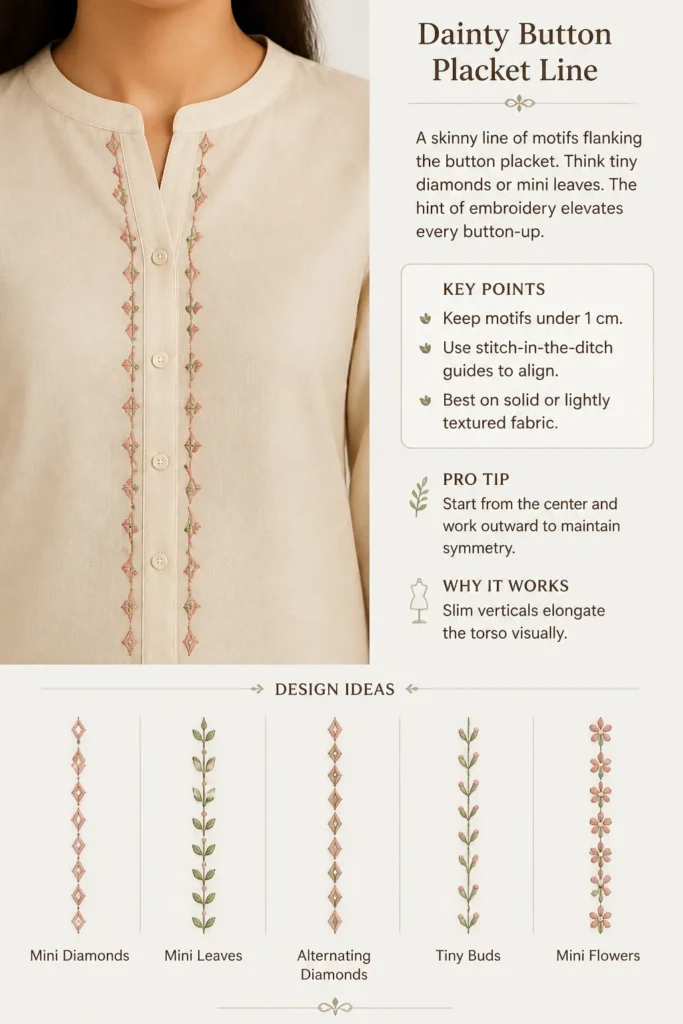
Key points:
- Keep motifs under 1 cm.
- Use stitch-in-the-ditch guides to align.
- Best on solid or lightly textured fabric.
Pro tip: Start from the center and work outward to maintain symmetry.
Why it works: Slim verticals elongate the torso visually.
9. Back Dori Motif Cluster
Small clustered motifs around the tie-back or dori area. It looks custom and photo-ready. Pick shapes like hearts, stars, or tiny florals.
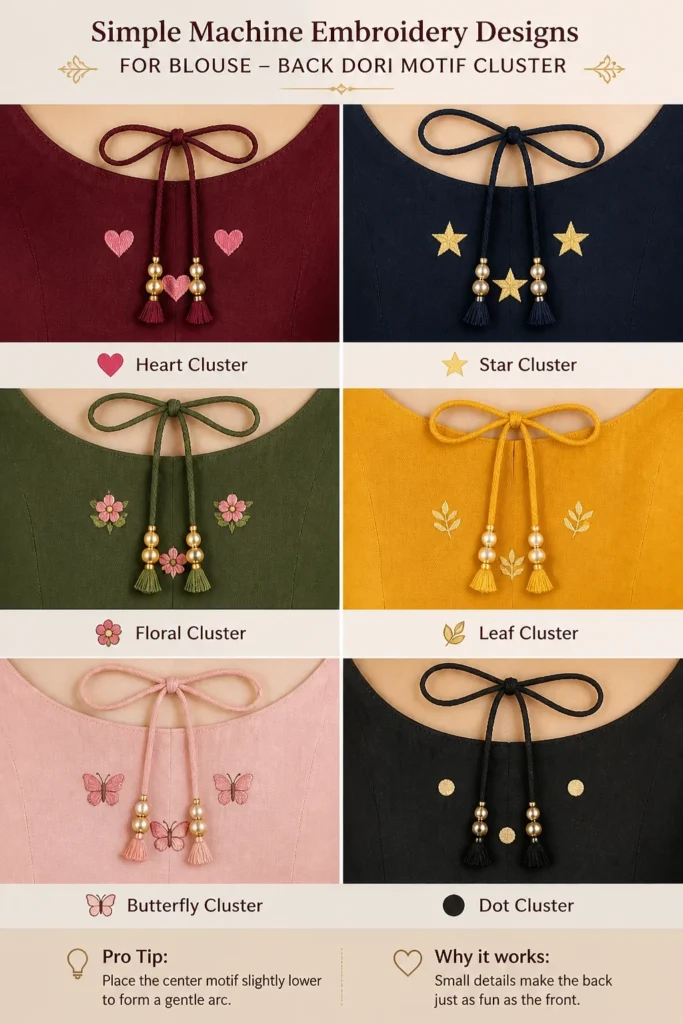
Key points:
- Three to five motifs look balanced.
- Use light stabilizer to avoid stiffness near ties.
- Match thread to tie color for cohesion.
Pro tip: Place the center motif slightly lower to form a gentle arc.
Why it works: Small details make the back just as fun as the front.
10. Hemline Running Stitch Waves
Soft wave lines along the hem using running stitches. Breezy, minimal, and beginner-friendly. Especially cute on peplum and A-line blouses.
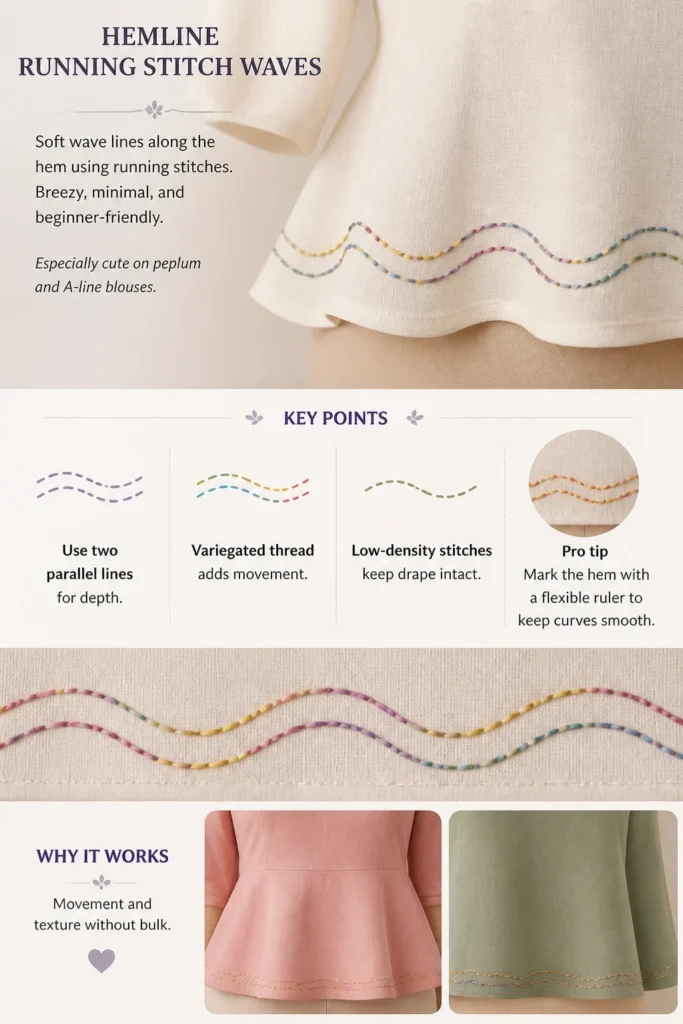
Key points:
- Use two parallel lines for depth.
- Variegated thread adds movement.
- Low-density stitches keep drape intact.
Pro tip: Mark the hem with a flexible ruler to keep curves smooth.
Why it works: Movement and texture without bulk.
11. Mandala Patch at Side Seam
A small mandala placed near the hip seam feels artsy and modern. It’s an unexpected placement that looks boutique-level. Keep it compact for easy stitching.
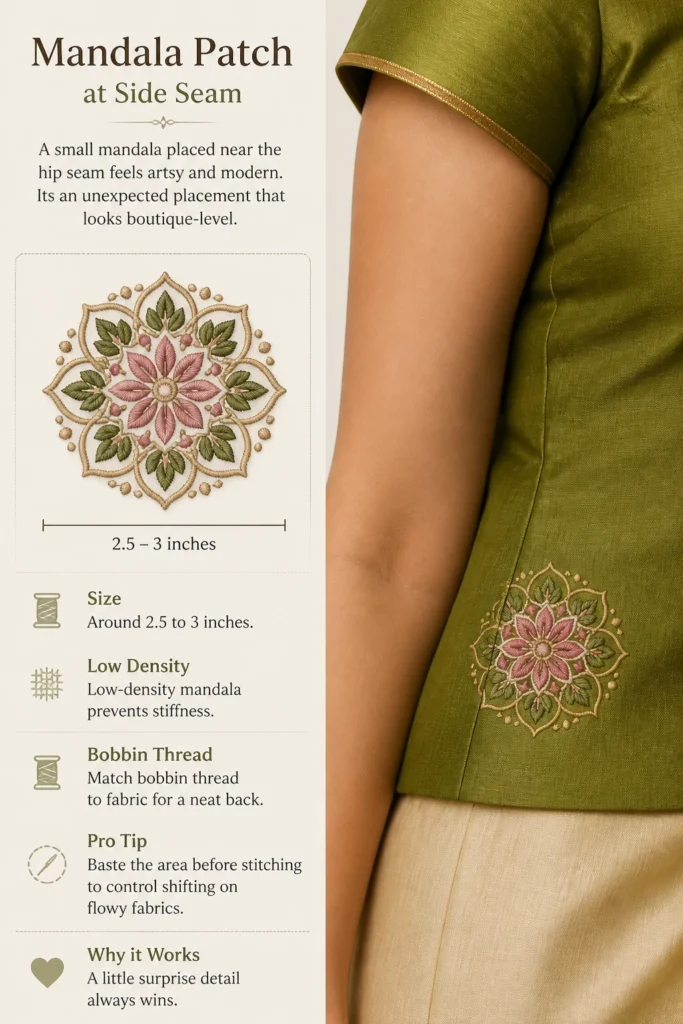
Key points:
- Size around 2.5 to 3 inches.
- Low-density mandala prevents stiffness.
- Match bobbin thread to fabric for a neat back.
Pro tip: Baste the area before stitching to control shifting on flowy fabrics.
Why it works: A little surprise detail always wins.
12. Collar Edge Satin Line
A neat satin-stitched outline on the collar edge. Minimal effort, strong payoff. It frames the face and pairs with everything.
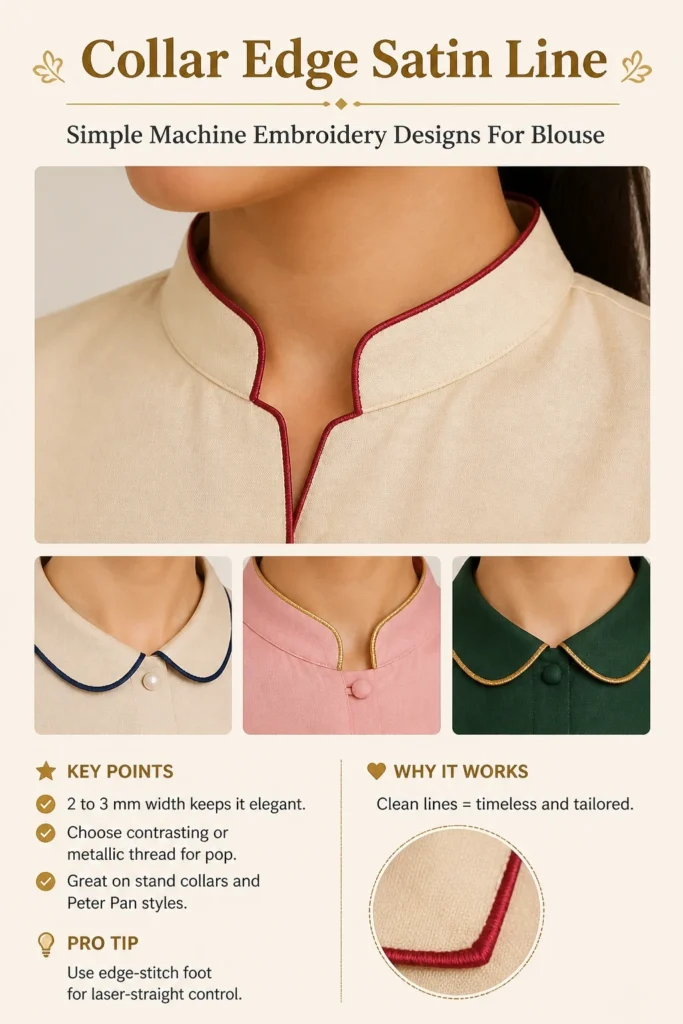
Key points:
- 2 to 3 mm width keeps it elegant.
- Choose contrasting or metallic thread for pop.
- Great on stand collars and Peter Pan styles.
Pro tip: Use edge-stitch foot for laser-straight control.
Why it works: Clean lines = timeless and tailored.
Conclusion
Simple embroidery doesn’t need drama to look designer. Pick clean shapes, smart placement, and friendly stitches, and your blouse goes from okay to oh hello. Keep it light, stabilize right, and let your thread do the flirting.
& CRAFT IDEAS
Beginner-friendly tutorials, creative projects,
and weekly inspiration in your inbox.